
A familiar scene has been replaying itself across Western capitals. In Australia, a crowd gathers, their signs decrying the cost-of-living crisis and housing shortages. A speaker’s voice rises, blaming record levels of immigration. The rhetoric, while focused on policy, subtly and sometimes not so subtly shifts to target specific communities. Recently, a sitting MP, Jacinta Price, pointedly connected the Labour Party to Indian migrants, suggesting a political motive for their influx, a statement that sent ripples of anxiety through the large Indian diaspora, including the Sikh community.

Meanwhile, in the United Kingdom, the "Take Back Control" mantra that powered Brexit has evolved into persistent protests against illegal Channel crossings. These rallies, often organized by right-wing groups, frame immigration as a threat to national culture and security. While the target is often Muslim communities, with speakers invoking the horrific grooming gang scandals predominantly involving men of Pakistani heritage, the atmosphere of intolerance created is a tide that lifts all boats of bigotry.

Sikhs, with their distinct religious identity manifested in turbans and beards, find themselves in a precarious position: caught in the crossfire of a heated debate they did not create, and vulnerable to becoming the next soft target.
A Spectrum of Discontent, A Common Thread
It is crucial to understand that the movements behind these rallies are not a monolith. They represent a spectrum of thought:
The Policy Critics: Those who argue against mass immigration, not immigration itself. Their concerns are often economic (wage suppression, strain on public services) and cultural (perceived challenges to integration). They demand a reduction in numbers and a more controlled system.

Protestors walking on Melbourne Streets at March for Australia Rally 31st August 2025 The Nativists and White Nationalists: On the far end are those who lobby for a "white nations" policy. Their opposition is not to the scale of immigration but to non-white immigration itself, viewing it as a form of "replacement."

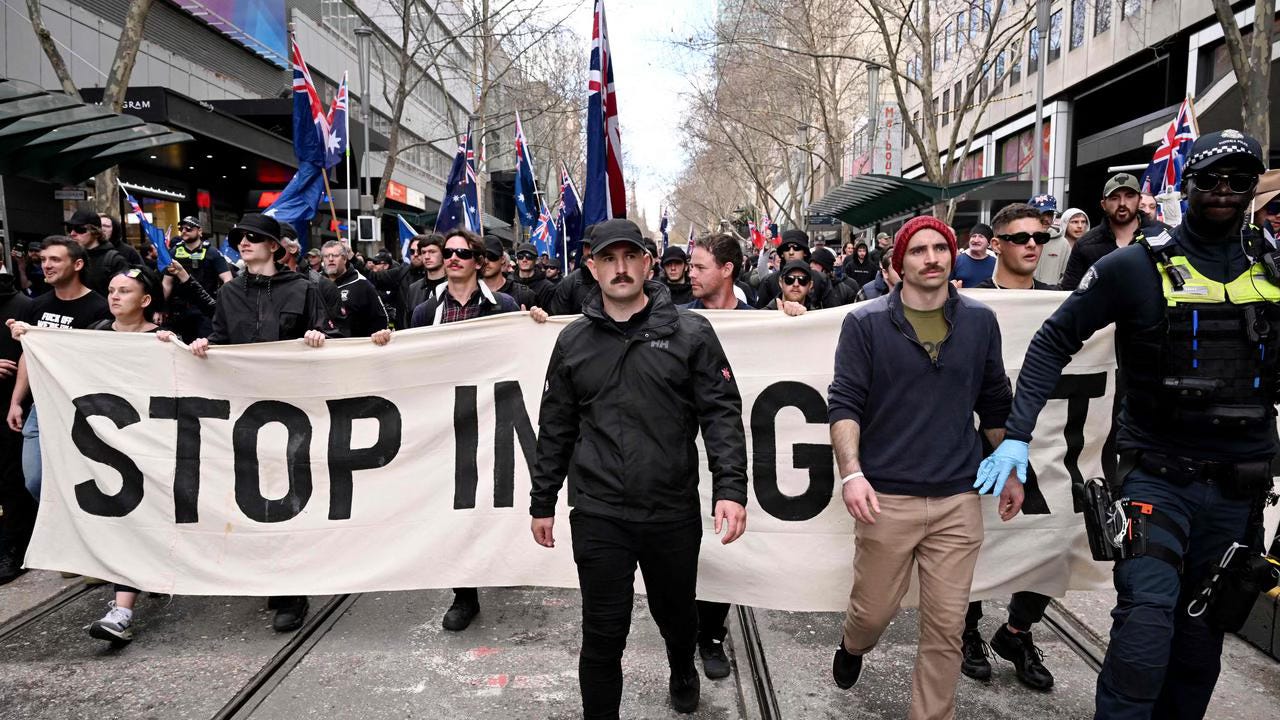
While the first group may argue in terms of policy, their events often provide a platform and a veil of legitimacy for the more extreme elements. The common thread that runs through all these rallies is the identification of the "foreigner" as the source of a nation's problems.
The Sikh Dilemma: Visible yet Voiceless
For Sikhs, this is a deeply troubling landscape. Their visibility makes them easy identifiers of "otherness." A turban, a symbol of faith and equality, can be misconstrued by a hate-filled protester as a symbol of the immigration they protest. This puts Sikhs at a heightened risk of hate crimes, a fear tragically validated by past events like the murder of Balbir Singh Sodhi in the USA post-9/11, a man targeted for his turban by someone seeking revenge against Muslims.
The irony is profound. In the UK, for instance, Sikh organizations like the Sikh Awareness Society (SAS UK) and individuals like Mohan Singh have been at the forefront for over two decades, raising awareness and combating the very same grooming gang scandals that anti-immigration rallies now cynically co-opt to fuel anti-Muslim sentiment. Sikhs have been allies in protecting vulnerable children, yet they risk being tarred with the same brush of xenophobia.
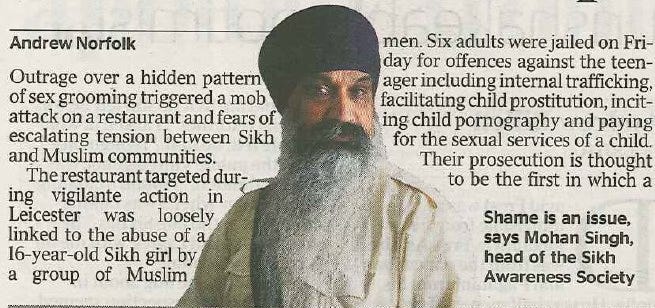
Now, with the rhetoric expanding to target "Indians" broadly as seen in Australia Sikhs are doubly vulnerable. They are perceived as both "Indian" and visibly different, potentially making them a primary target for a movement that is increasingly looking beyond Muslims
Finding a Path Forward: Beyond Reaction and Toward Solutions
The solution to this complex challenge cannot be merely defensive. It requires proactive, courageous, and nuanced action from within the Sikh community and in alliance with others.
Nuanced Community Advocacy: Sikh advocacy groups must double down on their efforts to educate the broader public. This means not only explaining who Sikhs are and what they believe but also actively engaging with media and policymakers to ensure the community is not lumped into a monolithic "immigrant" bloc. The narrative should highlight the contributions of Sikhs as farmers, doctors, soldiers, and taxpayers who are woven into the fabric of their nations.
Why Indians Targeted in Aussie Hate Storm | Podcast with Deepak Joshi
Building Strategic Alliances: The struggle against generalized hate is a shared one. Building bridges with other minority communities, including Muslim organizations, is essential. There is strength in a united front against bigotry, even while acknowledging and respecting different faiths and perspectives. Solidarity is the strongest antidote to divisive tactics.
Engaging with the "Policy" Debate, Rejecting the "Hate": It is possible to engage with legitimate concerns about housing and infrastructure without endorsing xenophobia. Sikh community leaders can participate in these conversations, advocating for a fair and compassionate immigration system that is also orderly and sustainable. This positions the community as a constructive partner in nation-building, not just a subject of the debate.
Promoting Sikh Stories: The most powerful tool to combat caricature is humanization. Sharing stories of Sikh service through langar (free kitchen) initiatives during disasters, their historical military service in both World Wars, and their community leadership replaces fear with familiarity. A public that sees a Sikh as a neighbour and a protector is less likely to be swayed by hateful rhetoric.
The rise of anti-immigration rallies is a test of Western societies' values of pluralism and tolerance. For Sikhs, it is a moment of acute vulnerability but also of opportunity an opportunity to firmly assert their place as a integral part of the Western mosaic, to stand against hate in all its forms, and to champion a discourse that is based on respect and shared humanity, not fear and division. The turban must not be a crossfire; it must stand as a beacon of resilience and hope in these divided times.