
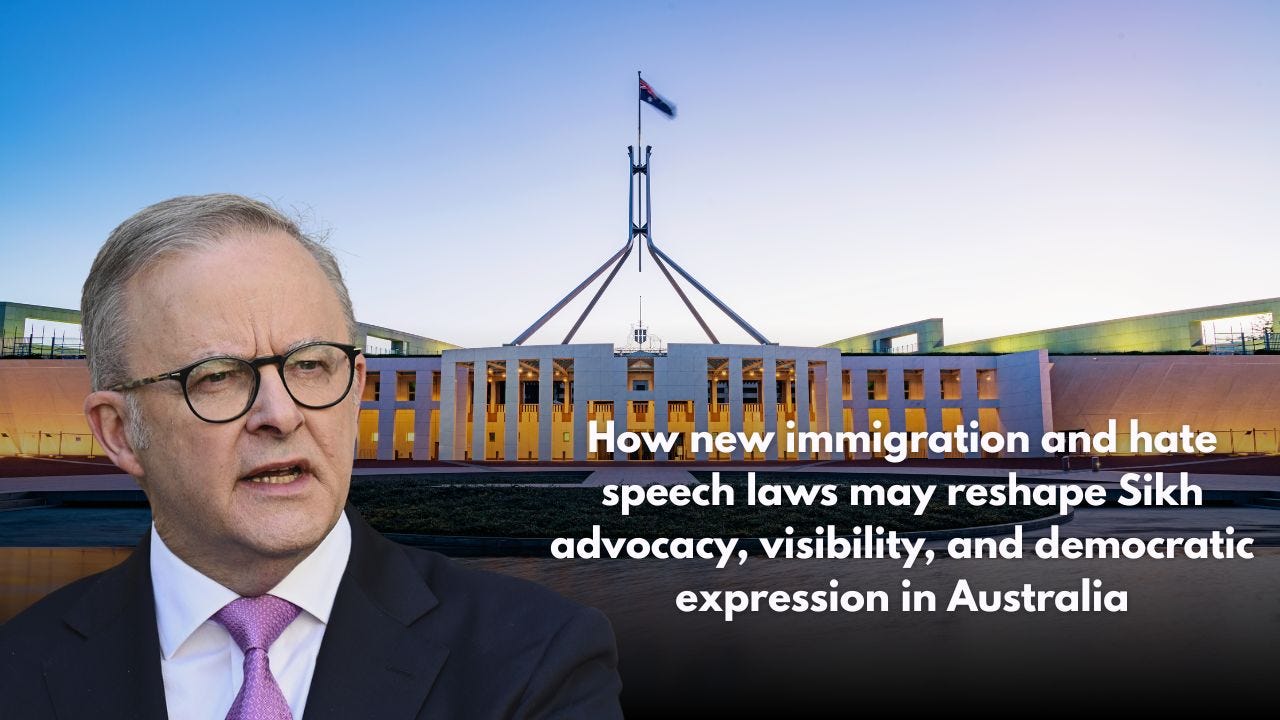
The recent violent attack at Bondi Beach shocked the nation and deeply affected Australians from all backgrounds. In response to growing concerns around public safety, extremism, and social cohesion, the Australian Prime Minister announced new immigration and hate speech laws aimed at preventing violence and curbing harmful ideologies. While these measures are presented as necessary for national security, they have also raised concerns among minority communities, including the Australian Sikh community, about potential unintended consequences.
Australia’s Sikh community is observing these developments closely, especially as the changes come at a time of heightened tension and scrutiny. In recent months, Australia has witnessed a rise in anti immigration protests and aggressive rhetoric. Due to their visible identity, Sikhs have increasingly found themselves targeted in public spaces and online discourse, despite being a peaceful, law abiding community that has contributed positively to Australian society for generations.
Following the Bondi Beach attack, Sikh organisations and gurdwaras across Australia were among the first to publicly condemn the violence and express solidarity with Australia and its people. Sikh institutions clearly rejected terrorism and hatred, standing firmly with the values of peace, safety, and unity. Community leaders urged calm, cooperation with authorities, and continued engagement with wider Australian society.
At the same time, the Sikh community carries a unique historical experience that shapes its approach to justice and human rights. Sikhs are survivors of what many scholars and human rights organisations describe as state sponsored violence and mass atrocities in India, particularly during and after 1984. This history has compelled Sikhs worldwide to openly speak about human rights violations and to condemn ongoing policies they believe continue to marginalise their community. This advocacy is rooted in remembrance, justice, and prevention, not hatred.
Across Australia, Sikh organisations regularly organise peaceful marches and awareness campaigns in major cities to highlight issues related to human rights in India. These events provide platforms to discuss historical injustices and to critique Indian state policies that Sikhs believe work against their religious and political rights. Such activities have always taken place within Australia’s democratic framework, respecting the principles of peaceful protest and free expression.
Internationally, India has faced accusations from countries including Australia, Canada, and the United States regarding attempts at foreign interference. Alongside these allegations, India has actively lobbied Western governments to restrict Sikh political expression abroad, particularly voices associated with the Khalistan movement. Indian officials frequently argue that Western democracies give too much space to Sikh activism, often framing it as extremism rather than political dissent.
This context raises serious questions for Australian Sikhs under the new legal framework. Will peaceful criticism of a foreign government’s human rights record continue to be protected? Could advocacy and protest be misinterpreted as hate speech or a national security concern? There is growing anxiety that new laws, if broadly interpreted, may discourage Sikhs from raising legitimate concerns out of fear of legal or political repercussions.
For the Sikh community, the issue is not opposition to law and order, but the need for clarity, fairness, and protection of democratic rights. Sikhs seek assurance that laws designed to combat hatred will not be misused to silence minority voices or suppress human rights advocacy. Australia has long been regarded as a country where difficult conversations can occur without fear.
As Australia moves forward with these policy changes, meaningful consultation with affected communities will be essential. For the Sikh community, the way these laws are applied will shape not only their ability to speak freely, but also Australia’s broader commitment to multiculturalism, justice, and democratic values.